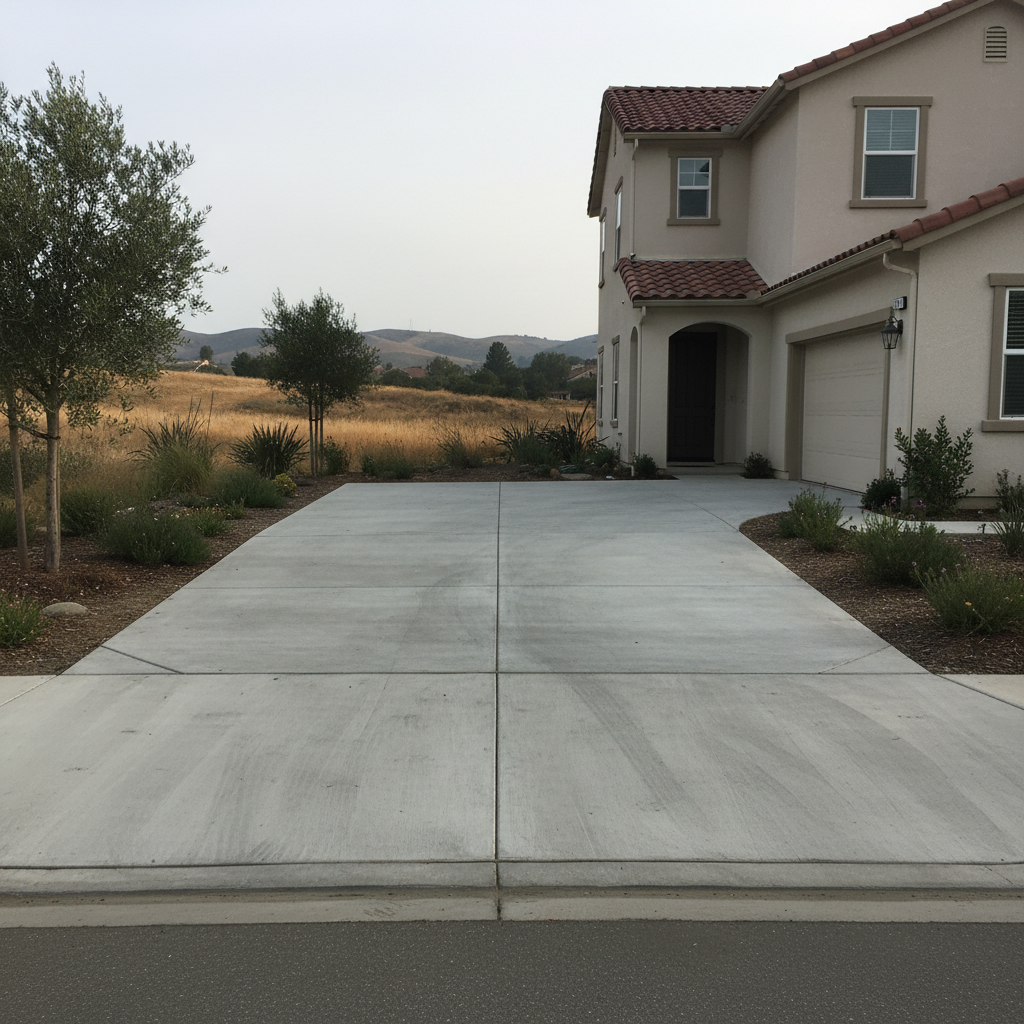
Concrete work looks simple from the driveway. Forms, a truck, a pour, a few days of waiting. What you can't see is the part that actually determines whether that slab lasts 30 years or cracks apart in five, and that's exactly the part a bad contractor will skip past in the sales pitch.
Check the license before you check the price
In California, concrete work falls under a C-8 classification with the Contractors State License Board. Any contractor pouring flatwork, a driveway, a retaining wall, should be able to give you a license number on request, and you can look it up yourself on the CSLB site in about thirty seconds to see if it's active, what classification it carries, and whether there are complaints or bond issues against it. A lot of homeowners skip this step because the guy seems nice and the bid is low. The bid is low sometimes because there's no workers' comp insurance behind the crew, and if someone gets hurt on your property that becomes your problem, not his.
Ask about permits too. The City of Torrance requires a permit for most new slabs and driveway aprons, especially anything that touches the public right of way or changes drainage toward the street. An inspector typically checks the forms, the base, and the rebar placement before the pour, and checks again after. A contractor who tells you permits are a waste of money, or that you don't need one for "just a patio," is telling you he doesn't want an inspector looking at his work.
What's happening under the slab matters more than what's on top
Torrance sits on a mix of soil types depending on where you are. Closer to the coast and in neighborhoods like Hollywood Riviera, you'll find sandier soil that drains reasonably well. Move further inland toward Lomita, Gardena, or some of the older flatland tracts, and you get more clay content, which swells when wet and shrinks when it dries out. Either way, concrete poured straight onto native soil without proper base prep is asking for trouble. A contractor should be compacting at least 4 inches of class 2 road base before any concrete goes down, more if the existing soil is soft or if there's old fill from decades of yard work and additions. Skip that step and you get a slab that settles unevenly within a year or two, no matter how good the mix is.
A lot of the housing stock in Torrance dates back to the 1940s through 1960s. Old Torrance, Walteria, and the tracts east of Hawthorne Boulevard have plenty of original driveways and walkways poured during that era, often with no rebar at all, sometimes with mesh that's rusted through or never properly chaired up off the ground. If you're replacing one of these, don't assume what's underneath matches what a contractor pours today. Ask what they're doing differently, because they should be.
Rebar, joints, and the mix itself
A standard residential driveway slab runs about 4 inches thick, sometimes 5 to 6 inches where heavier vehicles will sit, using a 3,500 to 4,000 psi mix. Rebar on a half-inch to 3/8-inch grid, tied and supported on chairs so it sits in the middle of the pour, not resting on the dirt, does more for long-term strength than almost anything else in the job. Wire mesh is cheaper and still common, but it tends to sink to the bottom during the pour if nobody's pulling it up, which defeats the purpose.
Control joints should go in within about 24 hours of the pour, cut to a depth of roughly a quarter of the slab thickness, spaced every 8 to 10 feet. These joints tell the concrete where to crack as it shrinks, instead of letting it pick its own spot down the middle of your new patio. If a contractor doesn't mention joint spacing at all, that's a gap worth asking about directly.
Curing time matters too. You can usually walk on a new slab after 24 to 48 hours. Driving on it takes closer to 7 days. Full design strength isn't reached until around 28 days, which is why a contractor who tells you to park a car on a driveway the next day is cutting corners, not saving you time.
How the Torrance climate changes the job
We don't get freeze-thaw cycles here, which spares South Bay concrete the damage that cracks up slabs in colder parts of the country. What we do get is a marine layer through late spring and early summer that keeps things cool and a little humid, which actually helps a slow, even cure. The risk shows up in the fall, when Santa Ana winds can dry out fresh concrete too fast if it isn't covered or kept damp, leading to surface cracking before it's even cured. A contractor who's worked here for any length of time knows to plan pours around those wind days and to cover fresh flatwork rather than leave it exposed.
Rainy season runs roughly November through March. Drainage planning during a pour matters because a lot of older Torrance lots were graded decades ago with minimal slope, and a new driveway or patio poured flat, or worse, sloped toward the house instead of away from it, turns a heavy January downpour into standing water at your foundation.
The red flags worth walking away from
- No written contract, or one that doesn't specify slab thickness, psi rating, and base depth
- A bid dramatically lower than two or three others for the same scope of work
- Asking for full payment upfront, before any material is delivered
- No mention of permits, or active discouragement from pulling one
- Vague answers when you ask about rebar versus mesh, or how thick the slab will be
- Pouring new concrete directly over old cracked concrete without removing it or addressing why it cracked in the first place
None of these by itself always means walk away. A contractor who doesn't volunteer every detail isn't automatically bad. But stack two or three of these together and you've got a pattern, not a coincidence.
Getting bids you can actually compare
Three contractors can look at the same driveway and come back with numbers that are nowhere near each other, because they're not all pricing the same job. One may be including full base removal and replacement, another may be pouring thinner over whatever's there. Ask each one for the slab thickness, the psi, the base depth, whether rebar or mesh is used, and who pulls the permit. Put it side by side and the real price difference usually makes sense once you know what you're paying for.
We've built our concrete contractor work around getting that foundation right before anyone worries about finish or color. The surface is the part you'll look at every day. The base and the rebar are the part that decides whether you're looking at it ten years from now or calling someone to tear it out.